The Marshall Pass Subdivision traces its origins to one of Colorado’s most vital and historically significant transcontinental narrow gauge corridors: the Denver & Rio Grande Railroad’s historic Third Division. Originally constructed in 1881, the line was built to conquer the Continental Divide at Marshall Pass, establishing a critical link between Denver, Salida, and the booming mining and agricultural communities of the Gunnison Basin and the Western Slope.
As the first rail route to cross the Rockies toward Salt Lake City, the line quickly became a dominant artery for Colorado commerce, moving vast quantities of silver ore, coal, timber, and livestock through some of the most unforgiving alpine territory in the United States.
Early Ownership and Consolidation
Like much of the Denver & Rio Grande Western’s (D&RGW) narrow gauge empire, the Marshall Pass line faced immense financial and operational pressures as the 20th century progressed. While the D&RGW standard gauged its main line through the Tennessee Pass corridor to handle heavier transcontinental traffic, the Marshall Pass route remained a narrow gauge operation, gradually transforming into a dedicated regional branch.
By the mid-20th century, dwindling mining traffic and the high costs of winter maintenance took a heavy toll. In 1953, the D&RGW filed for abandonment, and by 1970s, the rails over the pass were left dormant, seemingly ending the era of railroading over the 10,846-foot summit. For over a decade, the historic right-of-way sat dormant.
Transition to Regional Operations
The line’s fortunes changed drastically in the late 2000s. A massive industrial resurgence in the Tomichi Valley, coupled with the discovery of rich new mineral deposits in the Gunnison Basin, left the region’s mines desperately isolated from the national rail network. Recognizing the strategic value of an alternative southern crossing, and seeking to bypass the heavily congested, now Denver Terminal Railway controlled Tennessee Pass, a consortium of regional operators stepped in.
In late 2000s, the right-of-way was acquired from the state and private landowners. In an ambitious engineering undertaking, the corridor refurbished, widened, and standard gauged. Heavy continuous welded rail was laid, curves were eased where topographically feasible, and a primary operational hub was established at Montrose, marking the official birth of the modern Marshall Pass Subdivision. Sur Rail was selected to become the operator and maintainer of the rail line to service the Tomichi Valley.
Growth and Interline Cooperatives
With the Arvada Western Railroad’s parent company managing the corridor, the Marshall Pass Subdivision evolved into a critical high altitude bridge line, sustained by a complex network of corporate partnerships.
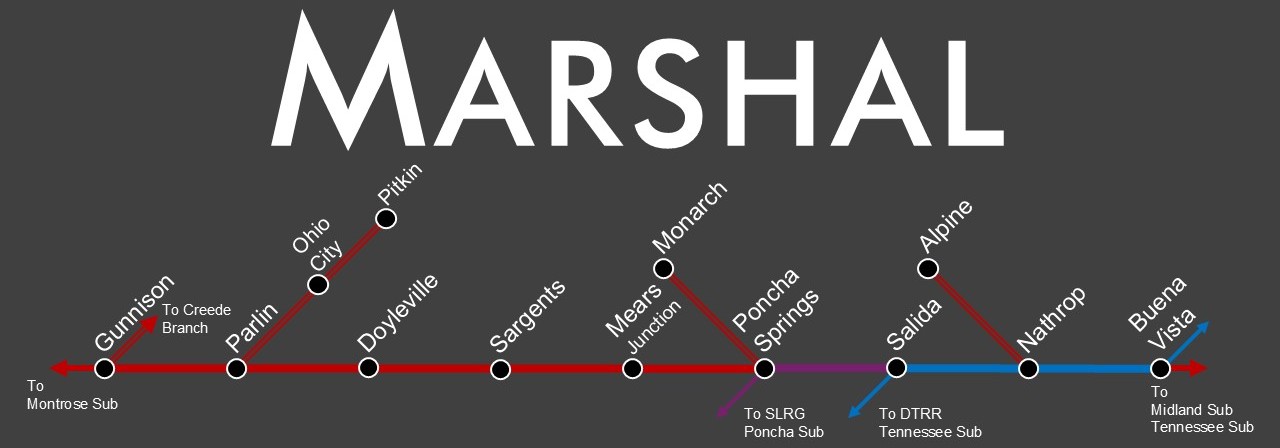
To the east, the line terminates at Mears Junction, establishing a seamless interchange with Arvada Western Railroad’s parent company’s other railroad, the San Luis Rio Grande Railroad (SLRG), which handles traffic moving south toward Alamosa and east into the sorting hubs of Salida. This connection proved invaluable to the Arvada Western Railroad, which utilizes trackage rights through the junction to route heavy unit trains to and from their steep Monarch Branch at Poncha Springs. Additionally, the line serves as a vital safety valve for the region; whenever The Denver Terminal Railway (The DT) experiences maintenance windows or winter closures on Tennessee Pass, The DT will exercise trackage rights and agreements to route hot manifest traffic over Marshall Pass.
This corporate synergy fueled a dramatic increase in freight density. Today, traffic remains robust, driven by steady unit stone trains from the Monarch quarry, outbound perlite and clean-coal from the Gunnison Basin, and steady lumber shipments from the Western Slope. State funded grants further improved the corridor, upgrading signaling and establishing a permanent winter preparedness fleet, including rotary snowplows and flangers, stationed at Sargents.
Once a nearly abandoned right-of-way, the Marshall Pass Subdivision has become a model of regional rail efficiency, safely guiding heavy tonnage across the Continental Divide and cementing its place as a cornerstone of Colorado’s modern freight network.
Trains
Arvada – Montrose Train
Manifest train between Montrose Yard and Tennyson Yard.
M-MONARV, M-ARVMON

Beer Cars, Barley, Wheat, Corn Syrup
Antero – Montrose Train
Manifest train between Montrose Yard and Antero Yard
M-MONANT, M-ANTMON

Paper, Gas, Lumber, Sand, Recycled Glass
Pitkin Train
Unit train between Pitkin Mines and Sandoval Steel in Pueblo, CO
U-PITSAN, U-SANPIT

Molybdenum
Public Service Company (PSC) Coal Train
PSC Coal train to/from Creste Butte Mine and the BNSF Fall River Division
C-CRECAL, E-CALCRE

Coal
Yankeetown Dock Corporation (YDC) Coal Train
YDC Coal train to/from Creste Butte Mine and the Yankeetown Dock Corporation
C-CREYDC, E-YDCCRE

Coal