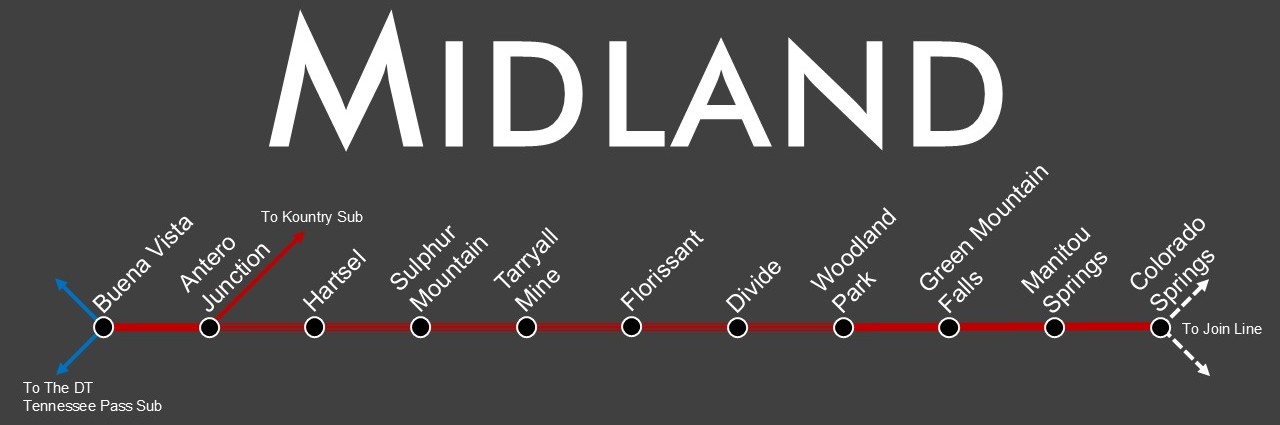
The Midland Subdivision traces its roots to the historic Colorado Midland Railway, once a bold trans-mountain route connecting Colorado Springs with the Arkansas River Valley. Though the original line disappeared in the early 20th century, its grades and engineering never fully vanished from the mountains.
The modern Arvada Western Railroad first reactivated the southern portion of this corridor through its Kountry Subdivision, operating between Buena Vista and Antero Junction. This segment quickly proved the value of the old Midland alignment, serving valley industries and local interchange traffic while restoring rail access to a region long dependent on highways.
A Corridor Driven by Industry and Agriculture
North of Antero Junction, the abandoned Midland grade toward Colorado Springs still held strong economic potential. At the same time, new local demands were emerging that gave the line fresh purpose.
East of Hartsel, renewed interest in a historic copper mining district began to take shape. Small but consistent output from reopened workings created demand for a reliable outbound freight connection, something trucking alone could not efficiently sustain in winter months.
At the same time, farmers across the South Park basin began pushing for better rail access for wheat and barley shipments. Seasonal harvest surges made highway transport unreliable, and grain producers increasingly viewed the old railroad corridor as the most efficient path to Front Range markets and interchange.
Together, mining and agriculture created a strong economic case for rebuilding the dormant northern route.
Rebuilding the Midland Subdivision
With the Kountry Subdivision already operating, the Arvada Western extended its reach northeast from Antero Junction, reclaiming the former Colorado Midland alignment in stages:
- Hartsel region: new freight spurs developed to serve copper mining operations and grain loading facilities
- Trout Creek Pass corridor: rehabilitation of long abandoned grades and stabilization of historic cuts and fills
- Ute Pass approach to Colorado Springs: reconnection to existing industrial trackage and interchange routes
By linking these segments, the railroad formally established the Midland Subdivision, completing a continuous route from the Arkansas Valley to the metro area of Colorado Springs.
Today’s Role
The Midland Subdivision now operates as a vital mountain freight corridor for the Arvada Western Railroad. Grain trains from South Park farms, copper loads from Hartsel, and general freight all move over a demanding route shaped by steep grades and historic engineering.
Together with the Kountry Subdivision, it forms a continuous system that follows the spirit of the original Colorado Midland, revived not as a memory, but as a working railroad once again.
Trains
Antero – Pueblo Train
Manifest train between Antero Yard and Pueblo Yard
M-ANTPUE, M-PUEANT

Molybdenum Ore, Crude Oil, Steel Coils, Gas, Molybdenum, Fertilizer
Antero – Montrose Train
Manifest train between Antero Yard and Montrose Yard
M-ANTMON, M-MONANT

Paper, Fertilizer, Coil Steel, Recycle Paper
Monarch Turn
Unit limestone train between Antero Yard and Monarch Mine
U-ANTMNA, U-MNAANT

Limestone
Alpine Turn
Unit Molybdenum train between Antero Yard and the Allie-Belle & Mary Murphy Mines
U-ANTMNA, U-MNAANT
Molybdenum

Hartsel Switch
Local train around Hartsel switching Tarryall Copper Mine and Farmers
L-ANTANT1

Copper Core, Wheat, Barely, Fertilizer
Antero – Buena Vista DT Transfer Train
Manifest train between Antero Yard and The Denver Terminal Railway’s Buena Vista Yard
M-ANTBUE, M-BUEANT
The Denver Terminal Railway Through Trains
The Denver Terminal Railway will often exercise trackage rights over the the subdivision towards Denver and Colorado Springs